The Story Behind the Name KI NO BI
“Our wish was to establish Japan’s first gin distillery in Kyoto—to create a truly distinctive craft gin together with the people of Kyoto.
Would it be possible to collaborate with Karacho in some way?”
This question marked the beginning of our story.
There is a saying that “God dwells in the details.”
KI NO BI is truly a bottle that embodies this idea. I still vividly remember the scene when we gathered in our atelier to discuss the bottle design.
In choosing the design, we selected a pattern from more than 600 woodblocks that have been preserved by Karacho since the Edo period. Together with the founders—David Croll, Noriko Kakuta Croll, and Marcin Miller—we chose Shochikubai Karakusa as the symbolic motif for the project.
The pine, bamboo, and plum represent auspicious blessings, while the karakusa vine expresses wishes for growth and prosperity.
Within this pattern were also small six-petaled motifs whose meaning was unknown.
David noticed them and asked:
“Could these perhaps represent juniper berries, an essential element of gin?”
I was deeply intrigued. Could a British gentleman truly understand the Japanese cultural sensibility of mitate—the art of metaphorical interpretation?
Mitate is a unique cultural practice in Japan. It means perceiving one thing through the form of another. In the worlds of waka poetry, haiku, and Zen gardens, this perspective transforms meaning and gives rise to new creativity.
Inspired by David’s remarkable sensibility—interpreting the six-petaled motif as berries, as tree fruit—our conversation sparked an idea within me.
From that inspiration came the name KI NO BI.
The name derives from the sound “kinomi,” meaning fruit of the tree, fruit of the season, or the fruits of nature. Instead of writing the character for fruit (mi), I replaced it with the character for beauty (bi). In doing so, the name came to express the blessings of seasonal harvests and the appreciation of the ever-changing beauty of the four seasons.
In other words, it reflects the spirit of Kyoto—a place where people cherish the beauty of the seasons and celebrate the aesthetics of nature throughout the year.
I wrote the name “KI NO BI” in my notebook that day.
That very name would later become the official name of the gin.
⸻
The Beauty of the Bottle
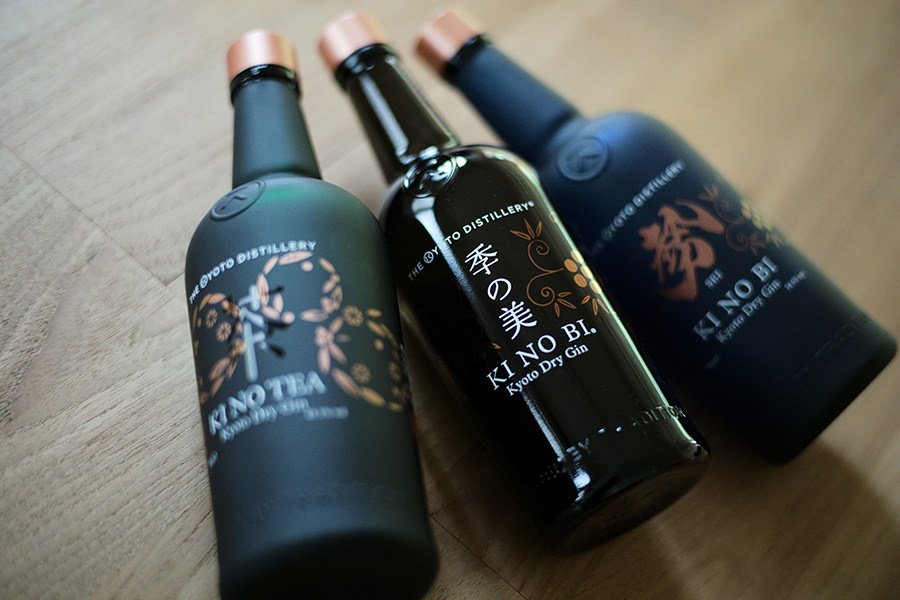
One of the most remarkable aspects of the KI NO BI bottle design is its beauty.
It is not merely a design.
The bottle was created from hand-printed karakami, produced with prayer and care.
It carries the warmth of human hands and the presence of traditional craftsmanship—an analog process that cannot be replicated by machines.
It is a uniquely beautiful bottle, infused with the power of a 400-year tradition and the quiet prayer embedded in its patterns.
True beauty is not only what we see.
It is also something we feel in the air.
The final value that preserves the authenticity of an original creation is its atmosphere.
I call this presence “kehai.”
Design and technology can be copied, but the true spirit and presence of an original work reside only in its origin.
For me, the beauty of KI NO BI also lies in the beauty of its brand philosophy.
The relationships with each producer, the careful selection of ingredients, the skill and passion of the distillery team, and the vision and determination of the founders—all of these invisible forces of beauty come together to give KI NO BI its presence in the world.
⸻
A Name that Carries the Story
KI NO BI has become one of the pioneering craft gins in Japan.
Beyond the meaning embedded in the name, I believe that the sound and rhythm of the name “KI-NO-BI” itself has played an important role in the brand’s success and in the story it continues to tell.
I sincerely hope that this story will travel around the world together with KI NO BI and be loved by people everywhere.
Choemon Senda